Showing posts with label energy infrastructure. Show all posts

Tuesday, November 30, 2010

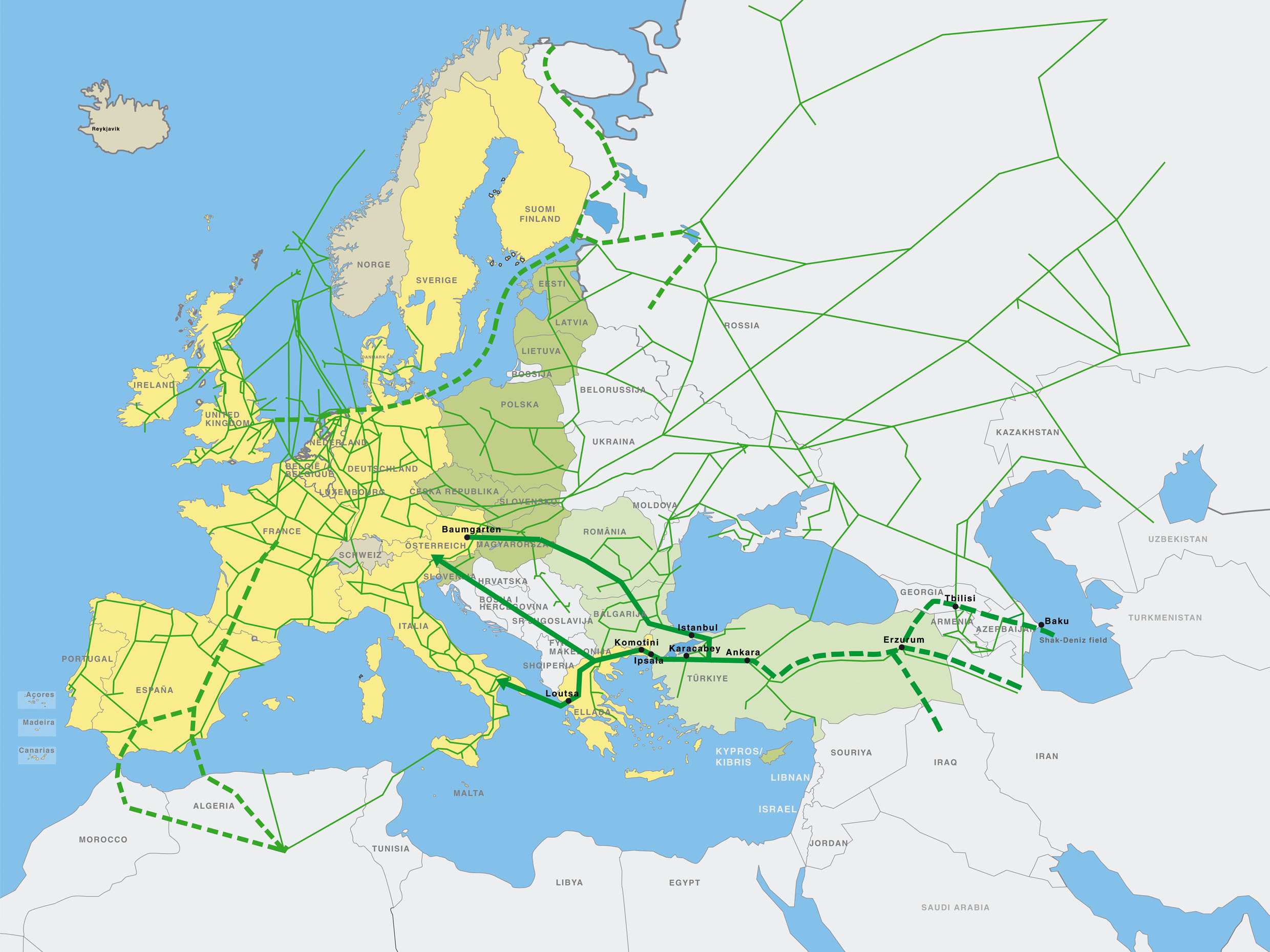
Bulgaria urges fiscal leeway for Nabucco financing

Bulgaria urged the European Union on Tuesday to allow countries in the Nabucco pipeline to write off bank guarantees they are to extend from their fiscal deficits, to show the gas link is a priority for Brussels. "We have always put the Nabucco pipeline as a priority ... But I have many, many remarks on the speed of work and on its actual, real position as a priority for the European Union," Bulgarian Prime Minister Boiko Borisov told an energy forum.

"My proposal is for member states in Nabucco, the bank guarantees that we will give to the European Investment Bank, or the European Bank for Reconstruction and Development ... to be written off the deficits of these countries," he said. Borisov said if the fiscal leeway was not provided, Bulgaria would be forced to breach the EU's threshold for a deficit of 3.0 percent of gross domestic product. Bulgaria's state company BEH is one of the shareholders in the 7.9 billion euros ($10.39 billion) pipeline, aimed to transport Caspian gas through Turkey and eastern Europe to Austria and cut the continent's dependence on Russian gas.

Other shareholders include Austria's OMV (OMVV.VI), Germany's RWE (RWEG.DE), Hungary's MOL (MOLB.BU), Romania's state-controlled Transgaz TGNM.BX, and Turkey's Botas.
Each shareholder has to provide about 2 billion euros in bank guarantees, the head of the Nabucco consortium, Reinhard Mitschek told reporters on the sidelines of the same forum.
Borisov's offer concerns Bulgaria and Romania, which will have to provide state guarantees for Nabucco. Borisov said Bulgaria would not block the project in case Brussels turned down its request, but said it would be a bad signal to Bulgaria and push it to an excessive budget deficit.
The Balkan country hopes to bring its fiscal deficit to 2.5 percent of GDP next year, after a prolonged recession and hidden deficits piled up by the previous Socialist-led government is likely to push its budget shortfall to 4.6 percent of GDP.

Last week, the spokesman of the Nabucco consortium said the first gas contracts for the Nabucco pipeline should be sealed by the middle of 2011 as gas supply talks with Azerbaijan had intensified.
The pipeline, which competes with Russia's South Stream gas pipeline, is expected to become operational in 2015.


News source: Reuters link: article

Thursday, November 18, 2010

Energy infrastructure: Commission proposes EU priority corridors for power grids and gas pipelines


The European Commission today presented its energy infrastructure priorities for the next two decades, aimed at making networks fit for the 21st century. In the Communication, the Commission defines EU priority corridors for the transport of electricity, gas and oil. This map of priorities will serve as a basis for future permit granting and financing decisions on concrete EU projects.

Günther Oettinger, Commissioner for Energy, said: "Energy infrastructure is key to all our energy goals: from security of supply, the integration of renewable energy sources and energy efficiency to the proper functioning of the internal market. It is therefore essential that we pull together our resources and accelerate the realisation of EU priority projects."

The Communication defines a limited number of EU priority corridors for which urgent development is needed to deliver on European Union policy goals of competitiveness, sustainability and security of supply by connecting those member states which are almost isolated from other European energy markets, by massively strengthening existing cross-border interconnections and by integrating renewable energy into the network. Based on these pre-defined corridors, concrete projects of "European interest" will be identified in 2012, which should benefit from EU financing and building permits, including a time limit for final decision while ensuring full respect of EU law, in particular environmental legislation and public participation. In planning and implementing these projects, the Commission favours regional cooperation between countries. It further defines longer-term goals, such as "European electricity highways".

In the electricity sector four EU priority corridors are identified:

* An offshore grid in the Northern Seas and connection to Northern and Central Europe to transport power produced by offshore wind parks to consumers in big cities and to store power in the hydro electric power plants in the Alps and the Nordic countries.
   
* Interconnections in South Western Europe to transport power generated from wind, solar, hydro to the rest of the continent.

* Connections in Central Eastern und South Eastern Europe, strengthening the regional network.

* Integration of the Baltic Energy Market into the European market.

In the gas sector, three EU priority corridors are identified:

* Southern Corridor to deliver gas directly from the Caspian sea to Europe to diversify gas sources.

*Baltic Energy Market Integration and connection to Central and South East Europe
  
*North-South corridor in Western Europe to remove internal bottlenecks and enable best use of possible external supplies.


News source: EU Press Room link: article

Friday, November 12, 2010

Bulgaria Govt Approves South Stream Joint Venture


Only days before a visit by Russian Prime Minister Vladimir Putin to Sofia, Bulgaria's Cabinet approved a joint venture to build and operate the Bulgarian section of the South Stream natural gas pipeline. The new business will be registered in Bulgaria and will be controlled on an equal-equity basis by state-held Bulgarian Energy Holding (BEH) and Russian gas giant Gazprom. The joint venture's capital will be sufficient to cover the respective stage of the project's development, Bulgarian Energy Minister Traicho Traikov said, without clarifying whether or not BEH will provide part of the funds.

Last week Bulgaria and Russia announced the launch of a tender for a feasibility study for the construction of the South Stream gas pipeline on Bulgarian territory, after months of uncertainty surrounding the project. The joint venture is expected to be signed when Russian Prime Minister Vladimir Putin visits Sofia on November 13. Putin will also discuss other large-scale energy projects in Bulgaria, including the Belene nuclear power plant and the Burgas-Alexandroupolis oil pipeline, with Bulgarian officials.

The South Stream gas transit pipeline is expected to be completed by 2015. It is estimated that its construction will cost between €19 billion and €24 billion. The pipeline will transport 63 billion cubic meters of natural gas annually, or 35 per cent of Russia's total annual natural gas export to Europe. In Bulgaria, the pipe is supposed to split in two, with one pipeline going to Greece and Southern Italy, and another going to Austria and Northern Italy through Serbia, Croatia and Slovenia. The project was initiated by Gazprom and the Italian company Eni, and the French company EdF has also indicated it may join as a shareholder. The pipeline is seen as a competitor to the EU-sponsored Nabucco project, which seeks to bring non-Russian gas to Europe.


News source: BalkanInsight link: article

Tuesday, November 2, 2010

Israel wants to invest in projects in infrastructure and tourism in Montenegro

During the meeting with Montenegrin Prime Minister Milo Dukanovic, Prime Minister of Israel Benjamin Natanyahu said that Israel and Montenegro have excellent foundations for the improvement of the economic cooperation, especially in tourism and infrastructure. He also said that Israeli investors are very interested in investing in Montenegro and are especially interested in projects in infrastructure and tourism. Their objective is to bring as many successful Israeli companies to Montenegro. According to Netanyahu, the fact that the role of Montenegro is crucial for stability in the region is one of the proofs that Montenegro is a safe partner.


News source: Limun.hr link: article

Friday, October 29, 2010

EIB supports capacity increase of gas transmission network and RDI in automotive sector in Slovenia


The European Investment Bank (EIB) is providing two loans in Slovenia:

* EUR 100 million to finance investments aimed at increasing the capacity of the gas transmission  infrastructure to meet the growing demand for gas in the country and
* EUR 50 million to support projects of small and medium-sized companies in the automotive sector to develop components for new generations of energy efficient cars

Mr. Anton Rop, EIB Vice-President responsible for lending in Central Europe, including Slovenia, stated: “Both loans will support Slovenia’s efforts to upgrade the quality of the environment in the country by increasing the availability of cleaner energy resources such as gas and reducing emissions by using the new generation of more energy-efficient power-trains”. 

The loan of EUR 100 million will help to implement the 2010-2013 investment programme focused on upgrading the capacity of the existing gas transmission infrastructure to better meet the increase in gas demand. This involves the construction of some 235 km of pipelines and compression facilities across the country

The loan of EUR 50 million to the Slovene Export and Development Bank (SID) will co-finance small and medium-sized investments aimed at increasing the environmental sustainability and safety of passenger cars and commercial vehicles. This is expected to be achieved through the development of components or systems for new generations of energy-efficient power-trains, weight reduction or other means of reducing emissions from vehicles, or through active or passive safety systems.

This loan represents the continuation of the EIB’s successful cooperation with SID. In July 2009 the Bank provided a loan of EUR 380 million to SID. Part of this loan (EUR 80 million) focused on the development of new generation vehicle technology and car emissions reduction. It has been fully allocated to 19 projects.


News source: EIB link: article

Tuesday, October 26, 2010

Nabucco: We don't accelerate spectacularly, but this is the only way to do projects of this kind

Nabucco, the gas pipe developed at European initiative to reduce dependence on Russian gas imports, has been overshadowed by the aggressive approach of Russians at Gazprom in the past few years, who make and break partnerships for their own gas pipe, South Stream. Nabucco representatives say projects of this kind are done in small, steady steps, and are certain building works will start in 2012.

"We don't take major leaps, we take small, steady steps. We don't accelerate spectacularly, but this is the realistic way to do projects of this size," says Christian Dolezal, spokesman for the Nabucco project. Nabucco shareholders are Transgaz (Romania), OMV (Austria), RWE (Germany), MOL (Hungary), Bulgargaz (Bulgaria) and Botas (Turkey). The maximum capacity of the pipe will be 31 billion cubic metres, it will cost 8 billion euros, and the pipe will be around 3,800-kilometre long. 


News source: ZF English link: article

Monday, October 25, 2010

Albania Talks on South Stream

Deputy Foreign Minister Vladimir Titov said Friday that Moscow might include Albania in the South Stream gas pipeline, which will carry Russian gas to southeastern Europe.
Titov said Russia would consider extending the planned pipeline to the small Balkan country, according to an Albanian government statement. Albania is not currently linked to any international gas pipelines.
Titov spoke after talks Friday with Albanian Prime Minister Sali Berisha.
South Stream will deal a blow to the rival Nabucco pipeline, which is supported by the United States and the European Union.
Austria, Serbia, Hungary, Slovenia, Greece, Italy, Bulgaria and Croatia have signed on to South Stream, which will lead under the Black Sea to Bulgaria. The joint venture between Gazprom and Italy's Eni will open in 2015.


News source: The Moscow Times link: article

Tuesday, October 19, 2010

EBRD-funded OMV Petrom power generation project on track

Romania’s first ever privately held power generation plant, which is being constructed with the support of EBRD financing, is on track to go into production by the end of 2011 when it will make a substantial contribution to the country’s energy requirements. OMV Petrom’s state-of-the-art new plant is a 860 MW combined cycle power gas turbine (CCGT) being built in the town of Brazi, north of Bucharest. When it is completed next year it will provide approximately eight to nine percent of total domestic output. Using the latest available technology, the facility will provide effective and reliable energy with a low environmental impact.

The EBRD is co-financing the construction of the energy efficient plant with a €200 million loan provided in May 2009, alongside a matching €200 million facility from the European Investment Bank.
The plant was visited on Monday by a delegation of the EBRD’s Board of Directors who are in Romania to get an update on the on the country’s investment priorities. In addition, the EBRD is supporting OMV Petrom to set enhanced standards in the industry with regards to environment, health and safety and to increase the energy efficiency. The EBRD financing will support a series of projects that include pollution clean-up, the replacement of outdated pipeline, health and safety measures and moves to increase efficiency. In March 2009, the EBRD provided a €300 million syndicated loan to ensure continuous implementation of environmental improvements at OMV Petrom despite limited availability of commercial funding.


News source: EBRD link: article

Friday, October 15, 2010

New Gas Pipeline Launched Between Romania and Hungary

The prime ministers of Romania and Hungary, along with EU Energy Commissioner Gunther Oettinger, on Thursday attended the launch of a gas pipeline that connects the two countries and allows Romania to import gas from western Europe. The project is an important step forward towards the creation of an efficient energy network in central Europe. For Romania it is also important because it lessens the country’s dependence on Russian energy,” said Romanian Prime Minister Emil Boc.The Arad–Szeged pipeline is 109 kilometres long and should transit 4.4 billion cubic metres of natural gas per year. It is part of the larger New European Transmission System, which is designed to unite central and southeastern Europe's natural gas transmission networks.

The total cost of the pipeline was around EUR 68 million. Romania produces some 13 billion cubic metres of gas a year, representing about 60 per cent of its annual needs. It imports the rest exclusively from Russia. While Romania is looking to reduce its dependence on Russian energy, it has recently shown interest in participating in the Russian-backed South Stream pipeline. Romanian and Russian officials on Wednesday agreed to carry out a technical analysis of possible Romanian participation in the gas transit pipeline. Local authorities, who in recent years have expressed their reluctance to take part in the project, have not commented further on the proposal, but local analysts said that Romania is interested in participating in the pipeline as the Balkan countries look to diversify gas supply routes. Romania has been a strong supporter of Gazprom's direct competitor, the Nabucco project, which aims to reduce European reliance on Russian gas by providing access to supplies from Azerbaijan and other central Asian countries.


News source: Balkan Insight link: article

Thursday, October 14, 2010

Romania, Russia Discuss Participation in South Stream

Romanian and Russian officials on Wednesday agreed to carry out a technical analysis of possible Romanian participation in the Russian-backed South Stream gas transit pipeline, according to Alexei Miller, CEO of the Russian gas company Gazprom.Miller made the announcement shortly after a meeting with Romanian authorities in Bucharest, including Prime Minister Emil Boc and Economy Minister Ion Ariton. He added that Russia is ready to start construction of the pipeline in 2013 and that the project is not a direct competition with similar proposed pipelines. Earlier this year, gas giant Gazprom invited Romanian state-run gas pipeline operator Transgaz to join the South Stream project.

Romanian authorities, who in recent years have expressed their reluctance to take part in the project, have not commented further on the proposal, but local analysts said that Romania is interested in participating in the pipeline. The South Stream pipeline is mainly backed by Russia, which will supply gas from Russia’s Black Sea coast through Bulgaria and Serbia to Hungary, Italy and Greece.
Romania has been a strong supporter of Gazprom's direct competitor, the Nabucco project, which aims to reduce European reliance on Russian gas by providing access to supplies from Azerbaijan and other central Asian countries. The projected Nabucco route runs through Turkey, Bulgaria, Romania and Hungary to its final destination in Austria.


News source: Balkan Insight link: article

Tuesday, October 12, 2010

Europe's southern gas corridor: The great pipeline race

Several pipeline projects are competing with one another to bring to life the southern gas corridor – a vague blueprint to supply Europe with gas from the Caspian and the Middle East. EurActiv takes a look at the various European initiatives, including their common competitor: Russia's South Stream project.
The 'Southern Gas Corridor' is seen as part of the 'New Silk Road' of transport and energy links between Europe and the Caspian region. EU politicians gave the project its name, while energy companies and governments are attempting to breathe life into it by pushing for concrete projects.
The best-known pipeline project in the southern gas corridor is Nabucco. But other smaller projects, such as the Trans-Adriatic Pipeline (TAP), the Turkey-Greece-Italy Interconnector (ITGI) or the Azerbaijan-Georgia-Romania Interconnector (AGRI) all have the potential to be an important element of the southern gas corridor and even call into question the future of Nabucco.

Some, like Russia's South Stream, even have the potential to becoming Nabucco 'killers' by making the flagship EU project irrelevant. South Stream, a planned pipeline carrying Russian gas to Europe, has a bigger capacity than Nabucco, similar target dates for completion and would largely reach the same Central European clients (see details in 'Issues'). In theory, South Stream could also carry gas from the Caucasus, as Russia's energy state monopoly Gazprom offers competitive prices to gas-producing countries such as Azerbaijan or Turkmenistan.

Alongside South Stream, a little-publicised project known as White Stream, a Ukrainian initiative, could also be seen as a competitor in the southern gas corridor, as it aims to bring gas from the Caucasus across Georgia and Ukraine to Romania with further supplies to Central Europe.
For Europe, building too many pipelines would make little sense. Although they would potentially introduce competition between different suppliers, the high construction costs would also likely inflate prices for consumers. On the business side, returns would be too small to justify several projects, meaning some will have to be abandoned.


Nes source: EurActiv link: article

Gasification of Central Bosnia Canton

BH-Gas d.o.o. Sarajevo (the Employer) intends applying the proceeds of a loan from the European Bank for Reconstruction and Development [the Bank] towards the cost of Gasification of Central Bosnia Canton. The Employer intends prequalifying firms and joint ventures, consortia or associations (JVCA) to tender for the following contract to be funded from part of the proceeds of the loan.

 This contract involves the construction of a DN400 (16 inch), 37 km (approx) high pressure steel gas transmission pipeline and 7 km (approx) of DN200 (8 inch) steel branch lines to enable gasification of four municipalities in Central Bosnia Canton by supplying gas to the towns of Busovaca, Vitez, Novi Travnik and Travnik. The pipes (according to API 5L), will be supplied by the Employer as Free Issue materials in Zenica, the remainder of the plant and materials will be supplied through this Works contract. The contract will be a combination of remeasurable items and lump sum prices under the FIDIC-MDB Harmonised Edition of the Conditions of Contract for Construction March 2006 all as defined in the Construction tender documents.


News source: EBRD link: article

Friday, October 8, 2010

RWE: Nabucco Decision No Earlier than 2011

German utility RWE AG Friday said a decision on whether to invest in the European Union-backed Nabucco natural gas pipeline will be made only in 2011.
"In light of the still pending gas supply contracts the original schedule can't be met" said an RWE spokesman, confirming a statement by Michael Ulbrich, an executive at OMV AG (OMV.VI) with responsibility for pipeline projects.

Ulbrich told Austrian newspaper Der Standard: "This year we certainly won't make it, it will be in 2011."
The shareholders in Nabucco, which is slated to carry Caspian region gas 3,000 kilometers to Western Europe, are Botas (Turkey), Bulgarian Energy Holding (Bulgaria), MOL (Hungary), OMV (Austria), RWE (Germany), Transgaz (Romania), each holding an equal share of 16.67%.
The European Union puts high hopes in Nabucco for effecting the much-vaunted European South Energy Corridor in a bid to ensure the security of gas deliveries to Europe and decrease dependence on Russia. It is seen as a rival to the South Stream gas pipeline project sponsored by Russia, to which Bulgaria is a also a party.


News source: Novinite.com link: article

Wednesday, September 29, 2010

Reservoir Files Applications for Hydroelectric Projects on the Cehotina River in Bosnia

Reservoir Capital said Tuesday it has filed government applications to build three run-of-river hydroelectric projects on the Cehotina River in Bosnia, with a combined capacity of 17.75 megawatts and an estimated output of 88 gigawatt hours per year.
The Cehotina River flows from Montenegro down into the Drina River at the town of Foca, where Reservoir's Bosnian office is located.

The company has applied for a 30-year concession covering the 26 kilometre section of the river within the Republika Srpska (an autonomous region of Bosnia and Herzegovina), which has an elevation drop of 114 metres and median flow rates ranging from 20 cubic metres per second at the Montenegrin border, to 23 cubic metres per second where it joins the Drina.
The total natural energy capacity for this section of the river is 24 MW, the company said.


News source: Proactive Investors link: article

Thursday, September 23, 2010

Azerbaijani, Turkish and Greek officials to discuss natural gas transportation

On October 11, officials of Azerbaijan, Turkey and Greece will meet in Athens to discuss transportation of Azerbaijan`s natural gas to Europe through Turkey, Taner Yildiz, Turkish Energy and Natural Resources Minister told journalists in Ankara.

In a joint news conference with Greek Minister of Environment, Energy, and Climate Change Tina Birbili, the Turkish minister said Turkey and Greece would establish a working group on the issue.
The Greek minister highlighted the importance of the Azerbaijani natural gas for his country, saying “Greece wants to increase gas imports”.
Birbili said Greece would also cooperate with Turkey in the field of power industry in the near future.


New source: EMG.rs link: article