Showing posts with label Russia's South Stream project. Show all posts

Friday, November 12, 2010

Bulgaria Govt Approves South Stream Joint Venture


Only days before a visit by Russian Prime Minister Vladimir Putin to Sofia, Bulgaria's Cabinet approved a joint venture to build and operate the Bulgarian section of the South Stream natural gas pipeline. The new business will be registered in Bulgaria and will be controlled on an equal-equity basis by state-held Bulgarian Energy Holding (BEH) and Russian gas giant Gazprom. The joint venture's capital will be sufficient to cover the respective stage of the project's development, Bulgarian Energy Minister Traicho Traikov said, without clarifying whether or not BEH will provide part of the funds.

Last week Bulgaria and Russia announced the launch of a tender for a feasibility study for the construction of the South Stream gas pipeline on Bulgarian territory, after months of uncertainty surrounding the project. The joint venture is expected to be signed when Russian Prime Minister Vladimir Putin visits Sofia on November 13. Putin will also discuss other large-scale energy projects in Bulgaria, including the Belene nuclear power plant and the Burgas-Alexandroupolis oil pipeline, with Bulgarian officials.

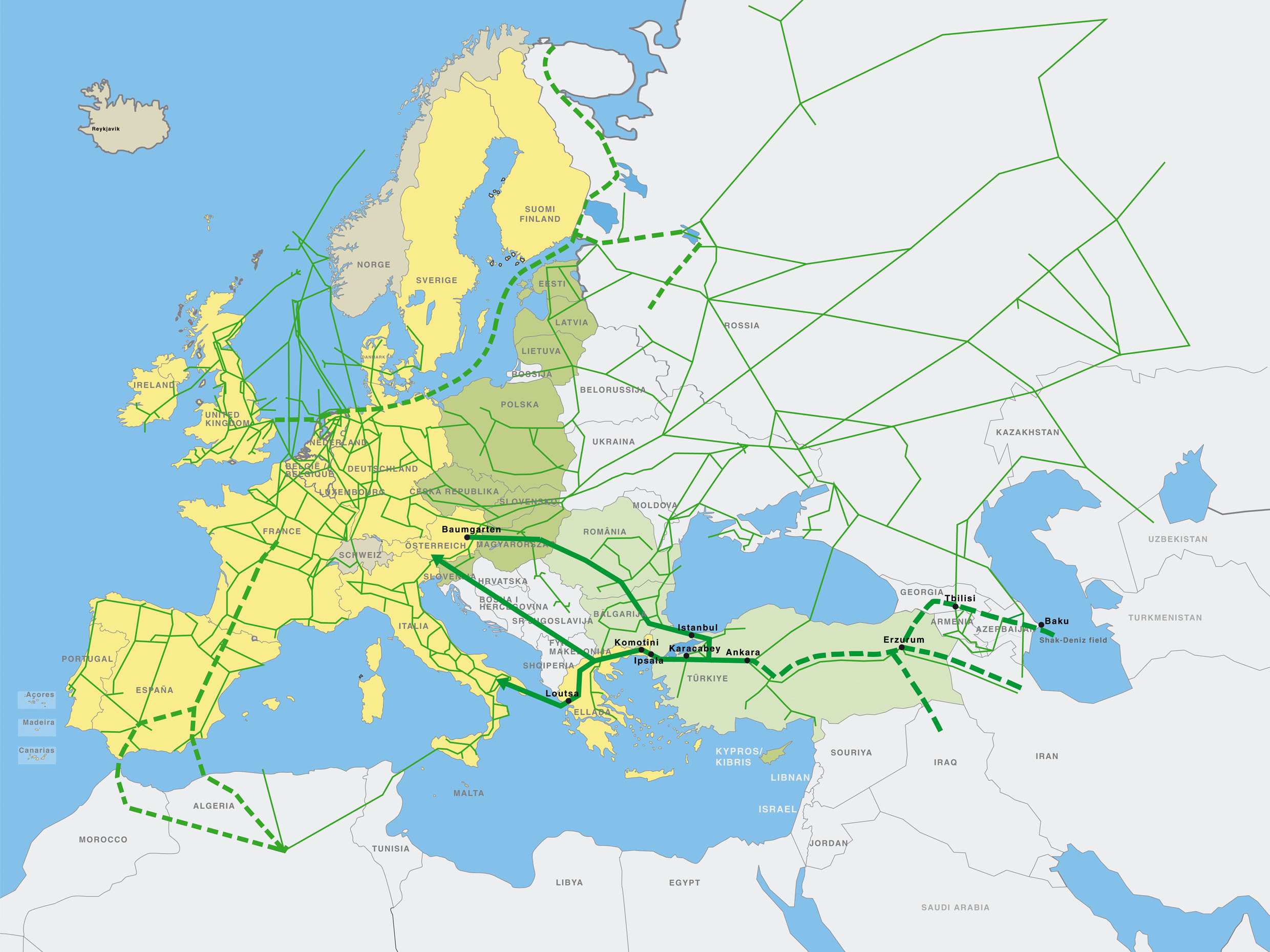
The South Stream gas transit pipeline is expected to be completed by 2015. It is estimated that its construction will cost between €19 billion and €24 billion. The pipeline will transport 63 billion cubic meters of natural gas annually, or 35 per cent of Russia's total annual natural gas export to Europe. In Bulgaria, the pipe is supposed to split in two, with one pipeline going to Greece and Southern Italy, and another going to Austria and Northern Italy through Serbia, Croatia and Slovenia. The project was initiated by Gazprom and the Italian company Eni, and the French company EdF has also indicated it may join as a shareholder. The pipeline is seen as a competitor to the EU-sponsored Nabucco project, which seeks to bring non-Russian gas to Europe.


News source: BalkanInsight link: article

Tuesday, October 26, 2010

Nabucco: We don't accelerate spectacularly, but this is the only way to do projects of this kind

Nabucco, the gas pipe developed at European initiative to reduce dependence on Russian gas imports, has been overshadowed by the aggressive approach of Russians at Gazprom in the past few years, who make and break partnerships for their own gas pipe, South Stream. Nabucco representatives say projects of this kind are done in small, steady steps, and are certain building works will start in 2012.

"We don't take major leaps, we take small, steady steps. We don't accelerate spectacularly, but this is the realistic way to do projects of this size," says Christian Dolezal, spokesman for the Nabucco project. Nabucco shareholders are Transgaz (Romania), OMV (Austria), RWE (Germany), MOL (Hungary), Bulgargaz (Bulgaria) and Botas (Turkey). The maximum capacity of the pipe will be 31 billion cubic metres, it will cost 8 billion euros, and the pipe will be around 3,800-kilometre long. 


News source: ZF English link: article

Monday, October 25, 2010

Albania Talks on South Stream

Deputy Foreign Minister Vladimir Titov said Friday that Moscow might include Albania in the South Stream gas pipeline, which will carry Russian gas to southeastern Europe.
Titov said Russia would consider extending the planned pipeline to the small Balkan country, according to an Albanian government statement. Albania is not currently linked to any international gas pipelines.
Titov spoke after talks Friday with Albanian Prime Minister Sali Berisha.
South Stream will deal a blow to the rival Nabucco pipeline, which is supported by the United States and the European Union.
Austria, Serbia, Hungary, Slovenia, Greece, Italy, Bulgaria and Croatia have signed on to South Stream, which will lead under the Black Sea to Bulgaria. The joint venture between Gazprom and Italy's Eni will open in 2015.


News source: The Moscow Times link: article

Friday, October 22, 2010

Bulgaria surrenders to 'South Stream' pipeline

Russian Prime Minister Vladimir Putin and his Bulgarian counterpart Boyko Borissov have agreed to set up a joint venture for the Bulgarian section of the South Stream pipeline, giving it a competitive edge over the competing Nabucco project supported by the EU. In a telephone conversation yesterday (21 October), Putin and Borissov agreed to establish a Russian-Bulgarian joint venture by 15 November that will conduct a feasibility study for the Bulgarian section of the South Stream pipeline.

The two leaders also confirmed their commitment to completing construction of the Belene Nuclear Power Plant ( NPP) and discussed the possibility of attracting third countries to the project, according to a statement published on the Russian government's website. During negotiating with Sofia, Moscow has been pushing forward its energy projects in Bulgaria as a package (see 'Background').
According to sources cited by Bulgarian daily Standart, Putin and Borissov will meet on 15 November to sign the deal, which is expected to include steps for building the Belene NPP. The venue of the meeting is not yet known.

The telephone conversation appears to mark the end of Borissov's strategy of giving equal treatment to the competing South Stream and Nabucco projects. It could also herald defeat in the prime minister's attempt to reduce his country's dependence on Russia for energy.
South Stream is designed to achieve full control over Bulgaria's gas pipeline network, experts warned recently. While Nabucco is stumbling over legal obstacles to laying its pipes on Bulgarian territory, its Gazprom-backed competitor, through the recent so-called 'Varna deal', includes a compromise solution for transporting some of the gas from South Stream via the existing Bulgarian gas pipeline network.


News source: EurActiv link: article

Thursday, October 14, 2010

Romania, Russia Discuss Participation in South Stream

Romanian and Russian officials on Wednesday agreed to carry out a technical analysis of possible Romanian participation in the Russian-backed South Stream gas transit pipeline, according to Alexei Miller, CEO of the Russian gas company Gazprom.Miller made the announcement shortly after a meeting with Romanian authorities in Bucharest, including Prime Minister Emil Boc and Economy Minister Ion Ariton. He added that Russia is ready to start construction of the pipeline in 2013 and that the project is not a direct competition with similar proposed pipelines. Earlier this year, gas giant Gazprom invited Romanian state-run gas pipeline operator Transgaz to join the South Stream project.

Romanian authorities, who in recent years have expressed their reluctance to take part in the project, have not commented further on the proposal, but local analysts said that Romania is interested in participating in the pipeline. The South Stream pipeline is mainly backed by Russia, which will supply gas from Russia’s Black Sea coast through Bulgaria and Serbia to Hungary, Italy and Greece.
Romania has been a strong supporter of Gazprom's direct competitor, the Nabucco project, which aims to reduce European reliance on Russian gas by providing access to supplies from Azerbaijan and other central Asian countries. The projected Nabucco route runs through Turkey, Bulgaria, Romania and Hungary to its final destination in Austria.


News source: Balkan Insight link: article

Tuesday, October 12, 2010

Europe's southern gas corridor: The great pipeline race

Several pipeline projects are competing with one another to bring to life the southern gas corridor – a vague blueprint to supply Europe with gas from the Caspian and the Middle East. EurActiv takes a look at the various European initiatives, including their common competitor: Russia's South Stream project.
The 'Southern Gas Corridor' is seen as part of the 'New Silk Road' of transport and energy links between Europe and the Caspian region. EU politicians gave the project its name, while energy companies and governments are attempting to breathe life into it by pushing for concrete projects.
The best-known pipeline project in the southern gas corridor is Nabucco. But other smaller projects, such as the Trans-Adriatic Pipeline (TAP), the Turkey-Greece-Italy Interconnector (ITGI) or the Azerbaijan-Georgia-Romania Interconnector (AGRI) all have the potential to be an important element of the southern gas corridor and even call into question the future of Nabucco.

Some, like Russia's South Stream, even have the potential to becoming Nabucco 'killers' by making the flagship EU project irrelevant. South Stream, a planned pipeline carrying Russian gas to Europe, has a bigger capacity than Nabucco, similar target dates for completion and would largely reach the same Central European clients (see details in 'Issues'). In theory, South Stream could also carry gas from the Caucasus, as Russia's energy state monopoly Gazprom offers competitive prices to gas-producing countries such as Azerbaijan or Turkmenistan.

Alongside South Stream, a little-publicised project known as White Stream, a Ukrainian initiative, could also be seen as a competitor in the southern gas corridor, as it aims to bring gas from the Caucasus across Georgia and Ukraine to Romania with further supplies to Central Europe.
For Europe, building too many pipelines would make little sense. Although they would potentially introduce competition between different suppliers, the high construction costs would also likely inflate prices for consumers. On the business side, returns would be too small to justify several projects, meaning some will have to be abandoned.


Nes source: EurActiv link: article