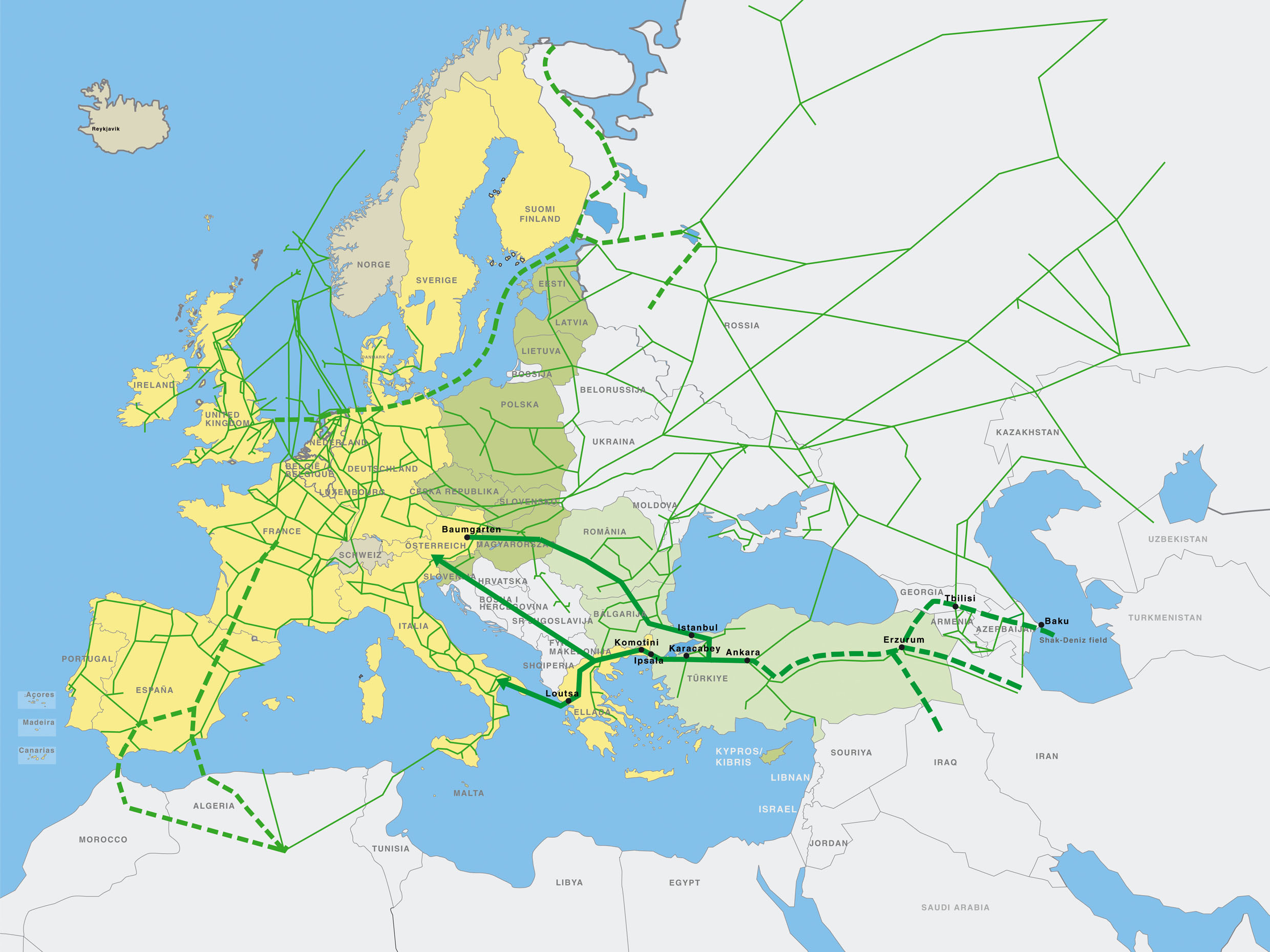
The 'Southern Gas Corridor' is seen as part of the 'New Silk Road' of transport and energy links between Europe and the Caspian region. EU politicians gave the project its name, while energy companies and governments are attempting to breathe life into it by pushing for concrete projects.
The best-known pipeline project in the southern gas corridor is Nabucco. But other smaller projects, such as the Trans-Adriatic Pipeline (TAP), the Turkey-Greece-Italy Interconnector (ITGI) or the Azerbaijan-Georgia-Romania Interconnector (AGRI) all have the potential to be an important element of the southern gas corridor and even call into question the future of Nabucco.
Some, like Russia's South Stream, even have the potential to becoming Nabucco 'killers' by making the flagship EU project irrelevant. South Stream, a planned pipeline carrying Russian gas to Europe, has a bigger capacity than Nabucco, similar target dates for completion and would largely reach the same Central European clients (see details in 'Issues'). In theory, South Stream could also carry gas from the Caucasus, as Russia's energy state monopoly Gazprom offers competitive prices to gas-producing countries such as Azerbaijan or Turkmenistan.
Alongside South Stream, a little-publicised project known as White Stream, a Ukrainian initiative, could also be seen as a competitor in the southern gas corridor, as it aims to bring gas from the Caucasus across Georgia and Ukraine to Romania with further supplies to Central Europe.
For Europe, building too many pipelines would make little sense. Although they would potentially introduce competition between different suppliers, the high construction costs would also likely inflate prices for consumers. On the business side, returns would be too small to justify several projects, meaning some will have to be abandoned.
Nes source: EurActiv link: article


No comments:
Post a Comment